Breathe smarter.
Watch it happen.
A breath pacer built on the resonance-breathing literature. On Apple Watch you can see your heart rate swing widen as you settle into the rhythm — and the trend it adds up to over weeks, read from Apple Health. Instead of asking you to take it on faith.
Free for 7 days, then from $4.99/month. iPhone & Apple Watch.
What it actually does
Two ways to watch it work.
One you can see inside the session. One that takes a few weeks and is worth more. Both come out of Apple Health, and neither of them is us telling you how it went.
During the session · Apple Watch
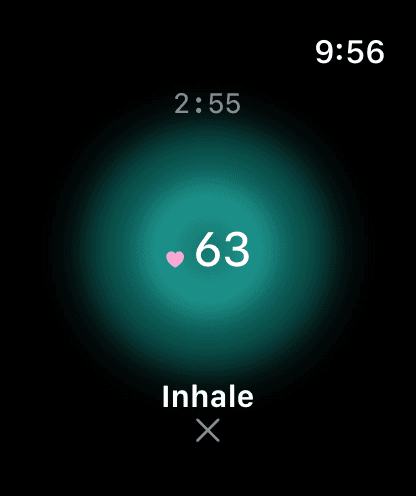
The swing, live on your wrist.
Your heart rate rises a little on each inhale and falls on each exhale. Slow down to six breaths a minute and that rise and fall gets wider — it is the most immediately visible thing about resonance breathing, and on the Watch you can sit and watch it happen in real time.
Live Pulse streams heart rate straight from the Watch and puts the readout inside the breathing blob. It shows you the swing as recorded. It does not score it, rate it, or tell you what it means.
No clear change
Schematic, not a screenshot — the grey dots are daily readings, the line is the rolling average.
Over weeks · Apple Health
The trend, and when there isn’t one.
HRV is noisy. A short night, a drink, a hard training session and a bad Tuesday all move it, which is why a single reading tells you almost nothing and the app does not dwell on one.
The Insights tab plots a rolling average against your own spread and marks the days you practised. When a week does not have enough samples, or the change is inside your normal scatter, it says no clear change— which is most weeks, and is a real answer rather than a missing one.
We can promise you the comparison. We are not going to promise you which way it goes.
Every session also ends with a check-in — how you feel compared to before. That one is subjective and it is always there, on every device, with or without a wearable. If a new HRV reading happens to land in Apple Health while you breathe, the completion screen shows it next to the last one recorded before you started. Usually one doesn’t, and we would rather show you nothing than show you noise.
Five techniques
Five ways to breathe.
Each one does something different.
Every technique in the app is mapped to a specific occasion — daily practice, acute reset, sleep, custom protocol. Pick the one that fits the moment.
Resonance
Six breaths per minute is the body's natural resonance frequency. The default and the one that improves HRV the most.
Box breathing
Equal inhale, hold, exhale, hold. Originally used by Navy SEALs for composure under pressure. Works because it forces metered attention.
4-7-8
Inhale four. Hold seven. Exhale eight. Long exhale shifts you parasympathetic fast — designed by Andrew Weil for falling asleep.
Extended exhale
Any ratio where exhale is at least twice the inhale. The mechanism behind why so many techniques work. Configurable.
Cyclic sighing
Double inhale, long exhale, repeated for five minutes. The protocol that beat box breathing and mindfulness meditation on mood in the 2023 Stanford trial.
The mechanism
Six breaths per minute is the rate the research keeps landing on.
In the HRV biofeedback literature, breathing at roughly six breaths per minute is described as bringing the respiratory rhythm into resonancewith the baroreflex — the feedback loop that regulates blood pressure beat-to-beat. Lehrer and Gevirtz’s review is the standard reference for why that particular rate is the one researchers keep returning to.
It is not a wellness theory. It has been measured in laboratories since the 1990s and refined into a documented protocol by Paul Lehrer and Evgeny Vaschillo. We link the papers rather than paraphrase them.
The breath pacer in this app is the same protocol — quieter, on your phone.
“Resonance frequency breathing maximizes heart rate variability via baroreflex resonance, with documented effects on autonomic balance and stress recovery.”
“Five minutes of cyclic sighing per day reduced state anxiety and improved positive affect more than equivalent mindfulness meditation.”
Programs
Or follow a journey.
Four multi-day programs: a structured first week, an evening routine, a morning one, and the slowest on-ramp we ship. Daily-locked, two-tap entry, no commitment.
7 days
HRV Bootcamp
Progressive resonance breathing that ramps from 6 BPM down to 5 BPM over a week. Each day builds on the last. Built for the first week.
Resonance · 3 → 10 min
5 nights
Sleep Wind-Down
Evening-focused 4-7-8 and extended-exhale patterns, five nights, done lying down with the lights already off.
4-7-8 · Extended Exhale
5 mornings
Morning Activation
Box breathing, then 7 BPM resonance. Designed for the first ten minutes of the day, before the inbox gets a say in them.
Box · Resonance 7 BPM
14 days
Gentle Start
The slowest on-ramp we ship. No breath holds, three-minute starts, and permission to repeat any day you like.
Extended Exhale · Resonance · Cyclic Sighing
Included in the subscription, like everything else. Seven days free first.
Apple Watch · Apple Health
Built around your wearable.
HRV Breathe reads your SDNN samples from Apple Health and builds them into a trend you can actually read across weeks. On Apple Watch it also streams live heart rate during the session, so there is something to watch while you settle into the rhythm — no phone needed.
Your HRV data never leaves your device. There is no server to compromise, no account to create, no analytics on your physiological data. We can’t see it because we never receive it.
Inhale
Common questions
The honest answers.
Do I need an Apple Watch?
What is HRV, in one sentence?
Is breathwork safe? Are there contraindications?
How long before the trend chart is worth looking at?
Is this a treatment for anxiety?
What does it cost?
Where does my data go?
Why is there no Android version?
Three minutes.
Then do it again tomorrow.
Free for 7 days, then from $4.99/month. iPhone & Apple Watch. No account.